Particle (Basic ㊦ 164)
A particle which marks an alternative.
Equivalent: (either) ~ or ~
| (i) {V/Adjective い} informal | か | |
| {話す /話した} か | Either someone talks/talked or | |
| {高い /高かった} か | Either something is/was expensive or | |
| (ii) {Adjective な stem/ N} | {Ø/だった} か | |
| {静か /静かだった} か | Either something is/was quiet or | |
| {先生 /先生だった} か | Either someone is/was a teacher or | |
| (iii) N1 か N2 | 先生か学生 | Either a teacher or a student |
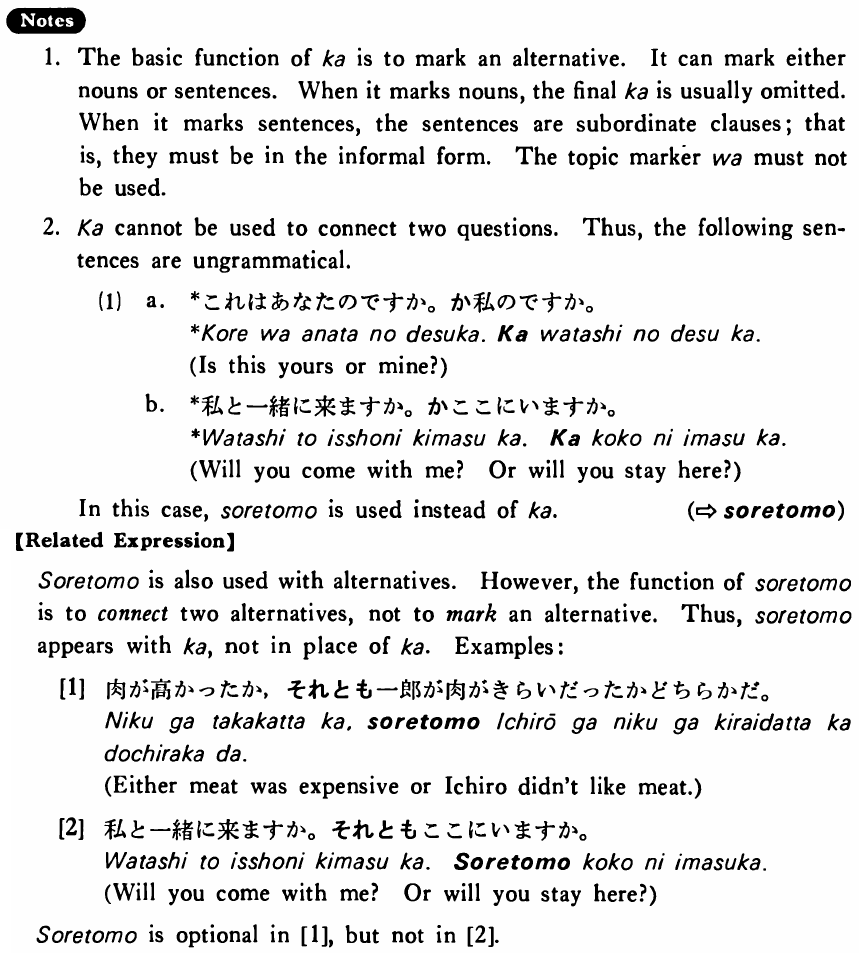
1. The basic function of か is to mark an alternative. It can mark either nouns or sentences. When it marks nouns, the final か is usually omitted. When it marks sentences, the sentences are subordinate clauses; that is, they must be in the informal form. The topic marker は must not be used.
2. か cannot be used to connect two questions. Thus, the following sentences are ungrammatical.
In this case, それとも is used instead of か.
(⇨ それとも)【Related Expression】
それとも is also used with alternatives. However, the function of それとも is to connect two alternatives, not to mark an alternative. Thus, それとも< appears with か, not in place of か. Examples:
[1]
[2]
それとも is optional in [1], but not in [2].